In any communications campaign, sending press releases is a very common tactic. Press releases are the documents sent to journalists to tell them about a piece of news or some relevant information about our company. The goal of a press release is for the media to pick up the story and, as a result, for it to reach a larger number of people.
But for this document to be truly relevant and spark journalists' interest, it is essential that you know the tricks and tips for writing a press release effectively. You need a type of announcement that combines creativity, detail and professionalism; only then will you get the attention you need for the press to publish an article about your news. Press release example:
If you want your communications strategy to succeed, we encourage you to keep reading this guide, where we will show you how to write a press release in 7 steps. It is the method you should follow if you want to catch the attention of the press and get your campaign to reach your whole audience.
The 7 steps to write a press release
Although how to write a press release may seem like a simple task at first glance, you should know that a press release has to be written with great care and full concentration. We must not forget that journalists receive hundreds of announcements like yours every day, so our mission is clear and concise: stand out from the rest.
And how do you achieve that? By knowing all the steps you need to follow to write an effective, appealing press release. Here they are in detail!
Step 1. The header of a press release
It is one of the most important elements of a press release, since it is the first thing the journalist will see in their inbox and it will determine whether they open or delete the email. So the header is essential when you write this type of document, and these are the elements it absolutely must include:
- Your brand logo. This way, from the very start, the outlet will know which company is sending the release.
- Add the words “Press release”. It is important to make clear that this document contains current, important information for the press.
- The date it is sent. You should also add the date on which the document is sent, so it can be verified that the information is up to date and breaking news.
- Multimedia elements. We live in a time when images are worth more than words, so don't forget to include a photo or a video in the header that relates to the content of your press release.
Step 2. The press release headline
Here comes one of the hardest parts of writing a press release. We're talking about the copy, that is, the words or the phrase that sum up the news in a short, eye-catching way. A headline has to be clear, concise and appealing; that way, it will catch the reader's attention and they will keep reading.
You need a headline that is informative and eye-catching at the same time. The ideal balance is 50% of each, and you should always make sure there is key information that sums up the content of the news.
We know. It sounds like “Mission: Impossible”, but it isn't. You just need to think about how you would sum up the information in one sentence and, once you have it, add original, fresh elements to catch the recipient's attention.
Tips for writing a good headline:
- Make it stand out with a larger, bold font.
- Avoid overused phrases and clichés.
- Don't make cheap jokes.
- Include figures that are round and real.
- Don't mention your brand (it isn't necessary)
- Keep the headline to 1 or 2 lines at most.
Step 3. The press release lead (or lede)
Another step in writing a press release is what is known as the lead (also spelled lede). This part of the release follows the structure of a news story and is the first paragraph of the press release. Here, you have to sum up the most important and striking information you want to communicate so that, just by reading this part of the release, the journalist already knows what you are talking about in a concise way.
To write a good lead, here are some tips that will be very useful:
- Put this part of the press release in bold.
- Try not to make it longer than 5 lines.
- In the lead, you should try to answer the 5 basic questions of a news story (the 5 Ws): what, who, when, where and why. Pick the ones that are truly noteworthy in your release, so you can condense the most important information for the media outlet.
Step 4. The body of the press release
After explaining the most relevant part of your news, now it's time to develop it and go into the details or the secondary information. What we have done when writing this first part of the press release is what is known as the “inverted pyramid”: we started with the most important part of the news and then we keep informing, adding the data that are not as relevant.
The trick is to go from MORE important to LESS important and, of course, anything that is not important at all does not go into this type of release. We need to provide information that is truly interesting to the press and, of course, to our target audience. Padding a press release with “filler” information is strongly discouraged.
Keep in mind that the information should be easy to read, so avoid paragraphs that are too long or that mix information. Our advice is to try to condense 1 idea into 1 paragraph and to order these ideas from most to least important.
Step 5. Information about your company
Once you have finished explaining the news in question, now it's time to introduce your company. You should include this addition because not all journalists know your brand or what it offers; so, after the main information, don't forget to add this short bio that sums up your company.
- What should you mention in this part of the press release?
- Who are you?
- What your company does
- Why are you different from the rest?
The point is not to make a sales pitch, but to introduce yourself briefly so the outlet can better understand who the release comes from. At most, use about 7 or 8 lines to talk about your brand, always with a friendly tone that is as non-promotional as possible, so the journalist does not lose interest.
Step 6. The contact details
Of course, a press release must always include the contact details so the journalist can easily find you if they want more information or want to write a story. At the end of the release, add these details about yourself:
- First and last name
- Position in the company
- Contact channels (phone, email, etc.)
- Link to the website
Step 7. The design and layout of the press release
Now that you know how to write a press release, we want to mention the last step, which, while not part of the writing itself, is essential for this type of release.
Going for an eye-catching design, aesthetically in line with your brand and with a clear visual structure is essential. But be very careful with this: the design should never overshadow the content. We want it to accompany and “dress” our press release, not hide it.
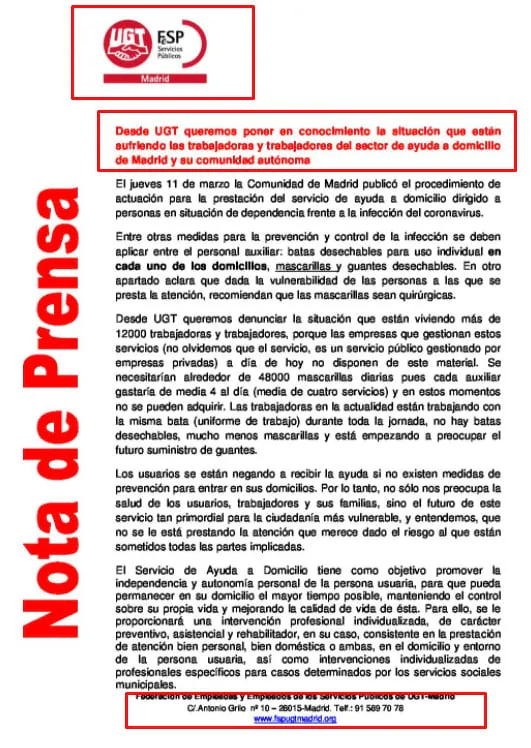
Let's use this example of a press release sent by UGT. As you can see, the header is the logo, where we can identify the organization and the regional branch (Madrid).
The first highlighted box is the headline of the press release. If you look closely, you can see that it is in bold, highlighted in another color and sums up the main idea of the release.
Next, we see the body of the message, preceded by the date on which the press release was sent. The message contains the information of the news, ordered from most to least important.
Finally, we find the contact details, made available to the media so that anyone who wants more information knows where to turn.
It is important to note that, in this case, the words “Nota de Prensa” (“Press release”) appear highlighted along one side of the release. It is a valid way to indicate what type of document this is, so the outlet knows at all times what information it is handling.
What this press release is missing, and what we mentioned in the steps, is the information about the organization. However, since it was sent by such a well-known name as UGT, no introduction would be needed in this case.
Here is another example of a press release, different from the previous one, that will also help us better understand the elements we have described:
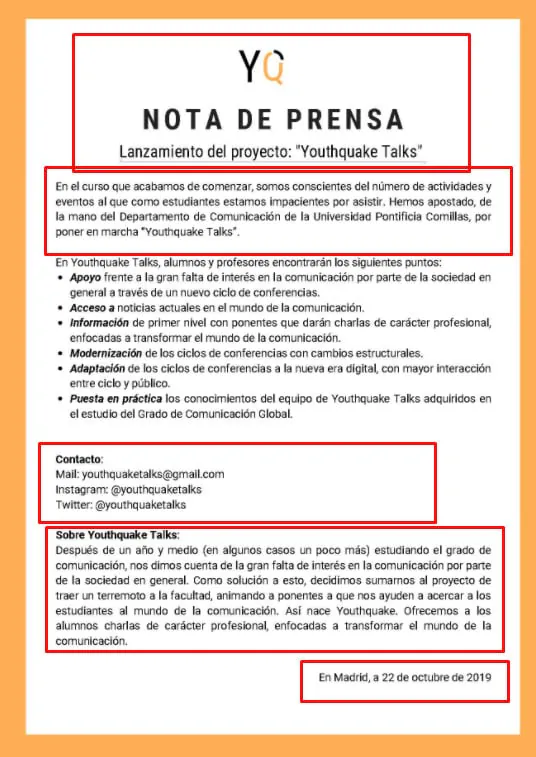
In this case, we see that the most important part of the release follows the structure we described: it starts with the header, continues with the lead and then moves on to the body of the message.
The main difference we see in this press release is that the contact details appear before the company information and that the date of the release appears at the end.
You can play with the secondary elements of the press release and arrange them however you like since, depending on your goals and on what you are looking for with the communications campaign, this structure can change slightly.
Press release examples:
A good example of a press release is one that starts with an attention-grabbing title that catches the reader's eye. For example, “Startup XYZ launches an innovative e-commerce app.” Here, the title is direct and makes clear what the press release is about.
The first paragraph should contain the most relevant information. In our example, it could be: “Startup XYZ, a technology leader, has launched a revolutionary e-commerce app that promises to change the way consumers shop online.” This sentence covers the basics: who, what and why it matters.
In the body of the press release, you provide additional details. For example: “The app, available on iOS and Android, uses artificial intelligence to personalize each user's shopping experience. With this new tool, Startup XYZ expects to increase its share of the e-commerce market.” This explains how the app works and what its goal is.
It is always important to include a statement from a spokesperson for the company, to give the press release a human touch. For example: “We are excited to launch this app. We believe it will change the way people shop online,” says Juan Pérez, CEO of Startup XYZ.
Finally, the press release should end with a call to action. For example: “For more information about Startup XYZ's new app, visit www.startupxyz.com.” This last step encourages readers to engage with the company.
Common mistakes in press releases
Besides knowing the essential points for writing a good press release, it is also worth knowing the most common mistakes you should avoid if you want your communication to be effective.
Here they are.
Choosing the headline
We have already said that it is one of the hardest parts of a press release, since you have to try to sum up the whole story in one or two sentences. The headline is the most decisive element and the one that will tip the balance toward an effective release or not, so we must pay close attention to it.
Some tips:
- Include the most prominent keywords of your news.
- Go for a short, eye-catching headline
- Include elements that make an impact and catch attention
- Don't overuse exclamation marks, capital letters or emojis
Should you include links?
This is a very common question when writing a press release. The truth is that it is useful for the recipient if you include a link where they can get more information, if they want to. But these links should always be:
- Valuable: they should give the journalist quality information
- Limited: add only one or two at most, so the release does not look like spam
- Visible: try to place the link in a visible, logical area of the press release
Too much information
A very common mistake when writing these releases is making the body of the message too detailed. Keep in mind that, as we have said, the information should provide valuable content and answer the 5 Ws of journalism.
If you want to offer more extensive information, it's best to include a link so the outlet can decide whether to dig deeper or not. But the press release should not exceed 500 words.
Not including multimedia
The two press release examples we have shown you share a common flaw: they have no audiovisual support. Nowadays, this is a big mistake, especially if we want to make an impact on the media.
Add a photo or embed a video in the release, so the information is easier and more pleasant to read when it arrives.
In the end, this will always boost keywords of the branded or brand-name type, which, although they are the most basic SEO, are also the words that, as a rule, enjoy a higher conversion rate.
Not saying anything new
A very common mistake is sending press releases that don't actually announce anything. In these cases, you should write another type of communication, such as a newsletter. But press releases have a clear goal: to announce something new.
Not including contact details
This is an element that must always appear in a press release. Even if you send it from a corporate email address, the media want you to include the contact details in the release itself, so they don't have to waste time looking for your information.
Where should I publish my press release?
If you want your news to reach a wider audience, there is nothing better than using platforms that offer mass distribution to quality media outlets.
At Growwer we offer you a catalog of national, international and local media outlets where you can send your press releases. You can get your news into leading media outlets and, that way, reach more people who are interested in your product or service.
With Growwer, all your releases can be published in high-quality newspapers, magazines or blogs that you can filter by location or by topic.
Press release examples
A good example of a press release is one that starts with an attention-grabbing title that catches the reader's eye. For example, “Startup XYZ launches an innovative e-commerce app.” Here, the title is direct and makes clear what the press release is about.
The first paragraph should contain the most relevant information. In our example, it could be: “Startup XYZ, a technology leader, has launched a revolutionary e-commerce app that promises to change the way consumers shop online.” This sentence covers the basics: who, what and why it matters.
In the body of the press release, you provide additional details. For example: “The app, available on iOS and Android, uses artificial intelligence to personalize each user's shopping experience. With this new tool, Startup XYZ expects to increase its share of the e-commerce market.” This explains how the app works and what its goal is.
It is always important to include a statement from a spokesperson for the company, to give the press release a human touch. For example: “We are excited to launch this app. We believe it will change the way people shop online,” says Juan Pérez, CEO of Startup XYZ.
Finally, the press release should end with a call to action. For example: “For more information about Startup XYZ's new app, visit www.startupxyz.com.” This last step encourages readers to engage with the company.