Showing up in ChatGPT's answers takes three things: its crawler can reach your site, your pages rank in the search engines it draws on and, above all, the sources it cites mention you. You cannot pay to be in the answer: ads, which reached Spain in August 2026, run separately and do not change it.
This guide explains how ChatGPT picks its sources according to OpenAI's documentation and the data-backed studies available so far, and what you can do at each step.
How ChatGPT searches the web
When a question needs current information, ChatGPT rewrites it into one or more narrower queries and sends them to external search providers. On its help page, OpenAI names Microsoft and Shopify as providers. It then writes the answer from the results and links some of the sources.
OpenAI says it ranks results using several factors and that placement is not guaranteed. And its publishers FAQ makes clear that any public website can appear, with no "optimisation" programme: the only technical requirement is not blocking its crawler.
1. Let OAI-SearchBot in
OpenAI runs three separate crawlers, and each one is allowed or blocked on its own in robots.txt (official documentation):
| Crawler | What it does | If you block it |
|---|---|---|
| OAI-SearchBot | ChatGPT search | Your site does not show up in answers with search |
| GPTBot | Model training | Your content is not used for training, but you can still appear |
| ChatGPT-User | Visits a user asks for from ChatGPT | OpenAI warns robots.txt rules may not apply |
Three quick checks:
-
Your robots.txt does not block
OAI-SearchBot. Changes take about 24 hours to apply. - Your CDN or firewall does not stop it: OpenAI publishes its IPs so you can allow them.
-
To keep a page out, use
noindexand let the crawler read it. With robots.txt alone the link can still appear.
2. Rank on Bing and Google, but do not stop there
Since ChatGPT searches through other engines, ranking helps. An analysis by Seer Interactive found that over 87% of citations matched Bing's top results (with a small sample of 500 citations). And SE Ranking, across 129,000 domains, saw that pages ranking higher on Google get more citations.
But ranking is not enough. In an Ahrefs study of 15,000 queries, only 8% of the links ChatGPT cited were in Google's top 10 for the same question. Most of what it cites is not your page but what others say about you.
3. Get mentioned by the sources it cites
This is the step that weighs most. According to Ahrefs, across 75,000 brands, visibility in ChatGPT relates far more to brand mentions on the web (correlation of 0.664) and on YouTube (0.737) than to the number of backlinks (0.194). Correlation is not causation, but the trend is clear.
Spain shows the same pattern. In the Mencoro study of 176,332 AI citations published by the Spanish outlet marketing4ecommerce, the brand's own website is only 4.8% of citations; other companies' sites in the industry add up to 72.6%, directories to 11.6% and the press to 4.3%. ChatGPT is the engine that leans most on the press and public bodies: 11.7% of its citations.
Which sources does it cite? In Ahrefs' US data, the most cited are:
- Forums and user content, led by Reddit (16.8% of citations).
- Reference works such as Wikipedia (7%).
- Media, review sites and comparisons.
And of the 1,000 most cited pages, 32.3% are ones you can influence: educational articles, reviews, news and blogs. That is where digital PR works:
- Articles on media and review sites that talk about your brand in the context of your customers' questions.
- Real presence on forums and on LinkedIn, which ChatGPT cites in 14.3% of its answers according to Semrush.
- Original data, which media cite and AI picks up.
To know where to start, the AI visibility checker tells you whether ChatGPT mentions you today and which outlets it cites for your industry.
4. Keep content up to date
In the SE Ranking study, pages updated in the last three months got 6 citations on average versus 3.6 for outdated ones, and pages over 2,900 words got 5.1 versus 3.2 for those under 800. On the other hand, adding FAQ schema or an llms.txt file showed no effect.
5. Measure the traffic that comes from ChatGPT
ChatGPT adds utm_source=chatgpt.com to the links it shows, and since May 2026 Google
Analytics 4 has its own "AI Assistant" channel that groups visits from ChatGPT, Gemini, Copilot and
other assistants. Some traffic arrives with no referrer (from apps or copied links) and shows up as
direct, so brand searches in Search Console are another good signal.
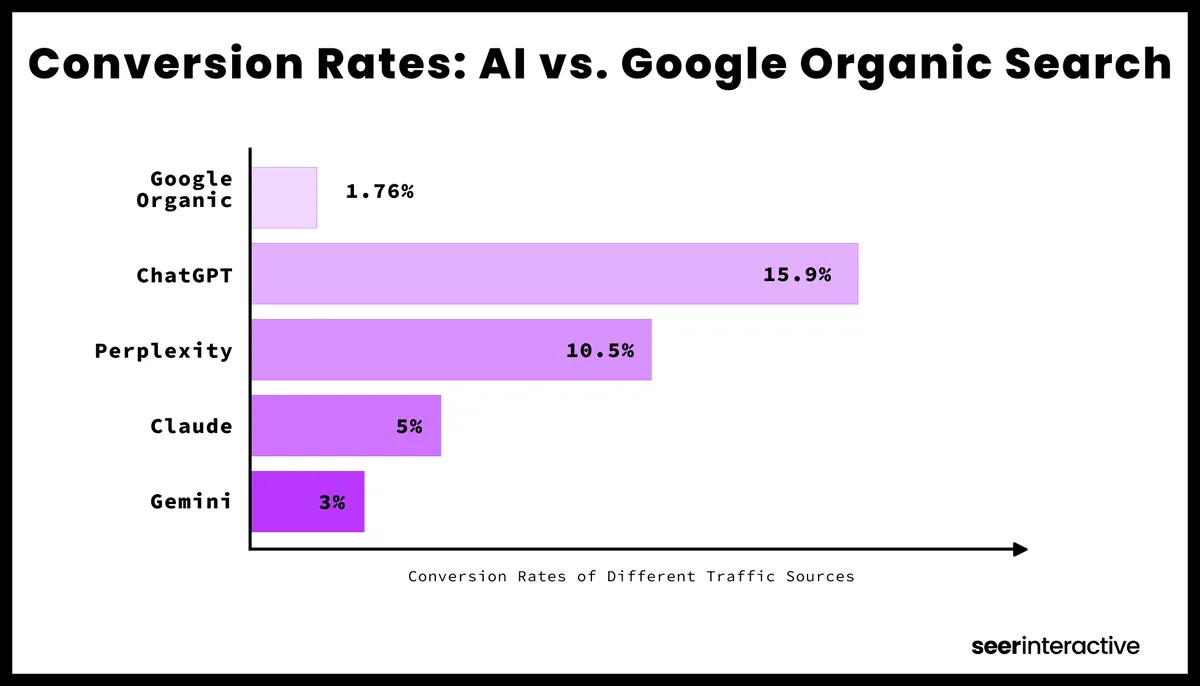
It is worth measuring: in a case study published by Seer Interactive, traffic from ChatGPT converted far better than Google organic.
What changes by industry
The steps are the same, but the outlets that matter change. These figures come from our report on media outlets cited by AI (42 brands in 8 industries in Spain, July to September 2026):
| Industry | Citations to outlets | Most repeated outlets |
|---|---|---|
| Retail and ecommerce | 7.7% | El País, El Español, OKDiario, La Vanguardia, Time Out |
| Legal, finance and insurance | 5.4% | El País, AS, La Vanguardia, elEconomista, 20minutos |
| Health, clinics and pharmacy | 4.4% | El País, Infobae, Cadena SER, ConSalud, La Vanguardia |
| Travel, events and leisure | 3.4% | El País, Cadena SER, Mundo Deportivo, AS, El Español |
| Industry and B2B services | 1.3% | El País, Interempresas, Cadena SER, AS, CdeComunicación |
- Online stores: the press weighs more here than anywhere else, on top of marketplaces and "best stores" lists. We cover it in how to get AI to recommend your online store.
- Law firms and professional services: AI cites "best lawyers in" city lists, directories with reviews and legal portals such as Iberley, Noticias Jurídicas or Confilegal, which are in our catalog.
- Clinics: medical directories with reviews and health outlets lead. A post signed by your specialist on a health outlet puts you next to those sources.
- Hotels and travel: 16.4% of ChatGPT's press citations go to the Condé Nast group (Traveler, Vogue), which has a content deal with OpenAI. Travel guides and magazines are the source.
- Industry and B2B: general press barely shows up; technical product pages and trade outlets such as Interempresas carry the weight.
What about ChatGPT ads?
OpenAI started testing ads in February 2026 and expanded them to Spain in August, with self-serve from 31 August. According to its help page, ads run on separate systems, are labelled as sponsored and advertisers cannot change or rank the answers. Product results are not ads either. Organic visibility in ChatGPT is still earned with the steps above.
Frequently asked questions
Can I pay to appear in ChatGPT?
Not in the answer. Ads appear separately, labelled as sponsored, and OpenAI says they do not influence what it answers.
If I block GPTBot, do I disappear from ChatGPT?
No. GPTBot is the training crawler. The one that decides whether you appear in search is OAI-SearchBot.
How long does it take?
robots.txt changes apply in about 24 hours. Media mentions depend on when they are published and indexed, so plan them weeks ahead.
Is it the same as GEO?
ChatGPT SEO is one part of GEO, which covers every generative engine. We explain it in GEO vs SEO.