
Maybe the name rings a bell, or maybe you have never heard of this technique at all. That is why, in this article, we are going to bring you up to speed on what link juice is and how it works in SEO. Read on!
What is PageRank?
Google assigns every website a score from 1 to 10. It is a very important factor that influences rankings, as it shapes Google's algorithm within the search engine.
Basically, it is a metric Google uses to measure how important your website is right now. To determine its score, what PageRank does is measure the links that point to your online platform and their quality.
To determine the PageRank of a specific page, Google assigns a numerical value according to its algorithm. So, the more quality links your website has, the higher this numerical value will be.
That said, this indicator is no longer public and it is not possible to see it in full. However, Google uses it internally, and it remains a very relevant indicator.
The factors Google takes into account when rating your website to raise or lower its PageRank are the following:
- Visits to the page.
- Quality of the visits.
- Value of the content.
- Web design.
- Loading speed. AMP pages get a higher rating because they are designed for compatibility with mobile devices, which speeds up page loading.
- Update frequency. `
All of these elements matter when determining PageRank, but the quantity and quality of web links matter most. That is why not all links work the same way: they need to meet certain characteristics. Those that come from pages with good ratings will support the website's PageRank, while the exact opposite happens with links from pages with poor scores.
The good news is that this rating can change, because Google runs periodic updates. So if your page has not earned a good rating, it is up to you to make as many changes as needed to improve it.
How do you calculate link juice?
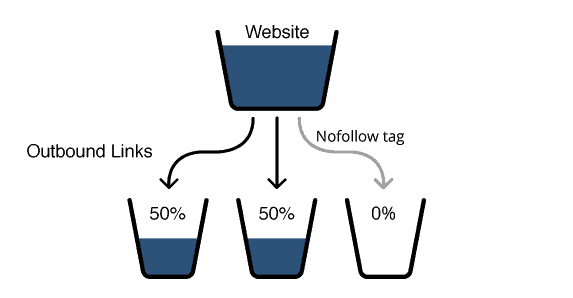
Link juice is the authority and value passed between the pages of your website through internal and external links. It is also known as link equity, and several factors influence it:
- Site authority,
- Relevance
- Number of internal links
- Link placement
- Topic
Pages that have plenty of external and internal links with strong link juice will have a better chance of appearing in the top results of search engines. To calculate it, the following criteria are used:
- Link relevance. This refers to how relevant the link is to the page being linked. It is important to clarify here that both websites, the linking one and the linked one, should offer content on a shared topic.
- Website authority. Websites with a longer track record and a substantial link history will have more authority than pages that have just launched.
- Link position. Links placed in the sidebar and in the footer (the bottom of the website) carry less weight.
What is the damping factor?
The term damping factor may ring a bell from the world of audio. However, it is now also part of digital marketing and is directly related to SEO.
It is very important on the internet because it refers to the loss of link juice, or, put another way, it is the estimated probability that a user gets bored while browsing a website, closes the browser or types another URL into the address bar.
It is a key figure for SEO specialists because it lets us quantify the authority that has been lost. As we have already mentioned, it is very important to Google that links coming from other pages have strong authority in search engines. It is a factor that always counts when it comes to ranking well. However, you need to be very careful, because the number of intermediaries can affect the result.
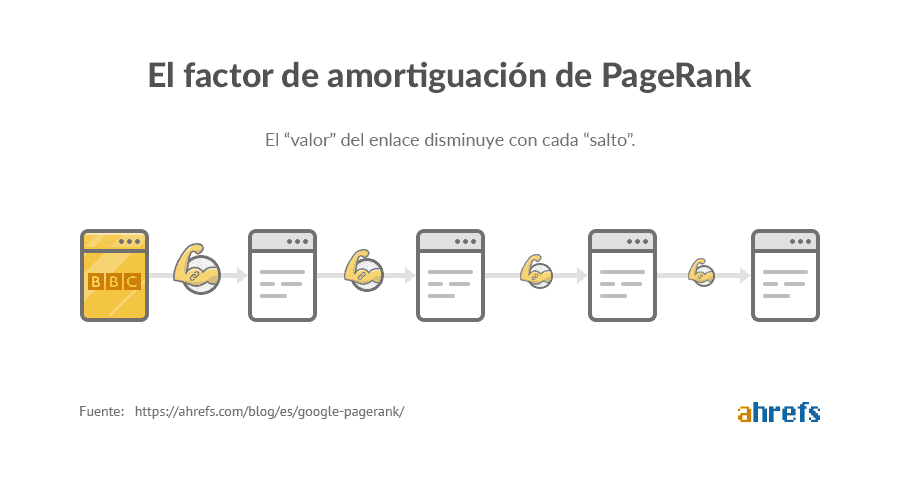
With the damping factor, we can measure how much difference there is when a website receives external links. It can also be used to carry out productive ranking strategies.
As we said, the damping factor is used to determine how much link juice has been lost when receiving links from other websites. To grow in SEO, having a certain level of domain authority is essential. It is the ideal way to increase our credibility with search engines and to know which links are the most beneficial.
With this measurement, specialists can work with different strategies and draw up new plans to find out which pages deliver the best results when it comes to getting more links, as well as orchestrate a network of links that helps improve our image in Google's eyes.
How can I optimize the distribution of link juice on my website?
Link juice is a simple technique that delivers optimized results in a short time. When it comes to improving the user experience and the ranking of a website, it is one of the most highly valued SEO strategies.
As we have already mentioned, the technique relies on page authority through the creation of internal links between the different URLs of a website. However, there are two types of link juice you need to keep in mind:
- External link juice when you link to external URLs
- Internal link juice when authority passes between your own URLs.
This term should not be confused with link building, an off-page SEO strategy that earns inbound links from other websites. Link juice, on the other hand, is an on-page SEO strategy, which means we control the outbound or internal links ourselves.
Tips to optimize link juice
The key to success with good link juice optimization is to put together a good strategy, and to make that possible you need to follow a few tips:
- Select the pages of the website that generate the most traffic. These pages stand out because their content targets keywords with high search volumes.
- Organize the content into keyword silos (SILO structure). The idea is to optimize the structure of the website with this SEO architecture technique to boost the relevance of the keywords in search engines.
- Optimize new blog content with the help of internal links.
- Make the most of the website's highest-authority pages. The goal is to create links that point to those pages, which, having more authority, always have links pointing to them from external websites.
Pay attention to the anchor text. In internal links, you can use the main keyword as anchor text, but it is advisable to vary the anchor text to find a middle ground, without going on too long or writing anything too forced.