Domain authority emerged as a key indicator that measures a website's relevance, trustworthiness and ability to rank in the SERPs.
In this article we'll take a deep dive into the concept of domain authority, exploring its importance, how it's calculated, the benefits of having a high DA and effective strategies to improve it.
What is domain authority?
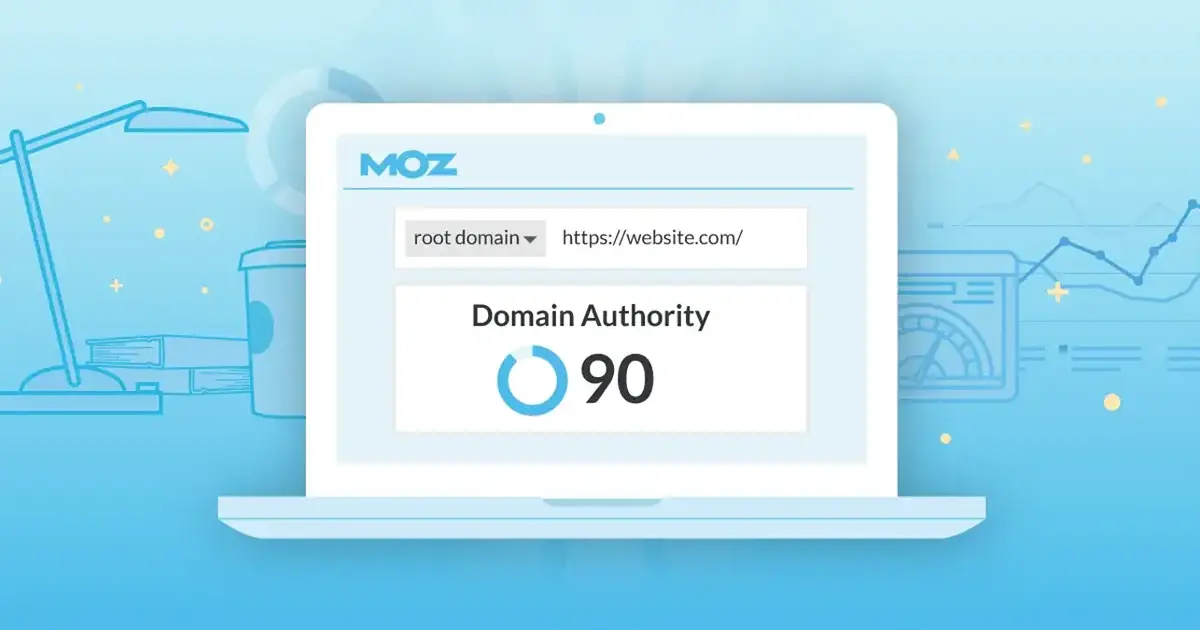
Domain authority (DA) is a metric developed by the company Moz that measures a website's relevance and its ability to rank in search results (SERPs).
This metric is shown on a logarithmic scale from 0 to 100, where higher values indicate a greater likelihood that the website will rank well in search results.
Although it's a useful tool for estimating a website's performance compared with its competitors, “it is not a factor that Google uses directly in its ranking algorithms”. Instead, it's a measure created to help websites better understand their relative ranking position.
The Google leak and authority
The recent leak of information about Google's algorithm offers new insights into how the company evaluates website authority, despite its earlier claims that it doesn't use metrics such as domain authority.
For example, it revealed a metric similar to “domain authority”, called “siteAuthority”, which reflects the perceived reputation and reliability of a site compared with its competitors. This component is very important in determining a site's position in the SERPs, which highlights its importance in optimization strategies.
This underlines the importance of understanding the criteria Google uses to determine the relevance and authority of sites in its search results.
It also reveals details about the importance of links and the role of indexing level in the value attributed to those links, offering a deeper view of how Google values and ranks content.
How is domain authority calculated?
Domain authority is calculated mainly based on the quality and quantity of backlinks pointing to a website. These links act as votes of confidence from other websites, and the more high-quality backlinks a site has, the higher its domain authority will be. In addition, domain authority is a domain-level metric, which means it evaluates the entire domain and its subdomains, unlike other metrics that may focus on individual pages.
There are other factors Moz takes into account when calculating DA, such as domain age, site content and user signals.
Why is domain authority important?
This metric offers important benefits that make it a valuable tool:
Competitiveness in your niche
For example, if your site has a domain authority of 60 and you're competing for a keyword against sites with domain authorities between 39 and 47, you can expect a good chance of ranking well.
However, if your competitors have domain authorities in the 80s, it may be wiser to target less competitive keywords. This helps you choose your keyword targets strategically to increase search traffic and conversions.
Link profile assessment
A site with high domain authority generally has a strong backlink profile, with high-quality links from other relevant, authoritative websites. This isn't always the case, so you would need to review the link profile.
Tracking SEO progress
Another important aspect of domain authority is its ability to track SEO progress over time. As SEO optimizations are implemented and a strong backlink profile is built, domain authority should increase.
Monitoring this metric lets you measure the effectiveness of your SEO strategies and adjust them as needed to improve results.
Competitor assessment
By analyzing the domain authority of the sites competing for the same keywords, you can determine how hard it will be to outrank those competitors in the SERPs.
If a site has a significantly higher domain authority than its competitors, it has a considerable competitive advantage.
What is considered a good domain authority?
There is no specific number that indicates a good domain authority score. A new website, for example, will have a DA score below 10, which is normal and doesn't necessarily indicate a problem with the site; it simply hasn't built a significant backlink profile yet.
DA scores tend to vary by industry and type of content. Some types of websites, such as those focused on software, often have high traffic volumes and many high-quality backlinks. On the other hand, websites focused on niche topics may face a less competitive search environment, and so need fewer backlinks to rank well.
As a general guide, we can rely on the following ranges:
- 0-10: Probably a new website that can only rank for very specific niche
searches.
- 11-25: This range suggests the site is legitimate in Google's eyes, but it
doesn't yet have a solid SEO track record. It has the potential to rank for industry-specific
keywords, but it will need to build more links.
- 26-40: A site in this range isn't top-tier yet, but it has an established
brand and/or a quality backlink profile.
- 41-60: A high-authority site. It's on its way to becoming a leader in its
industry and probably already has a successful SEO strategy.
- 61-80: A top-tier backlink profile. A site with this score can rank for most
terms in its industry, is trustworthy and has relevant content for commonly searched keywords.
- 81 and above: Usually reserved for big brands and websites that are well known worldwide, such as YouTube and Wikipedia.
How can I find out my domain authority?
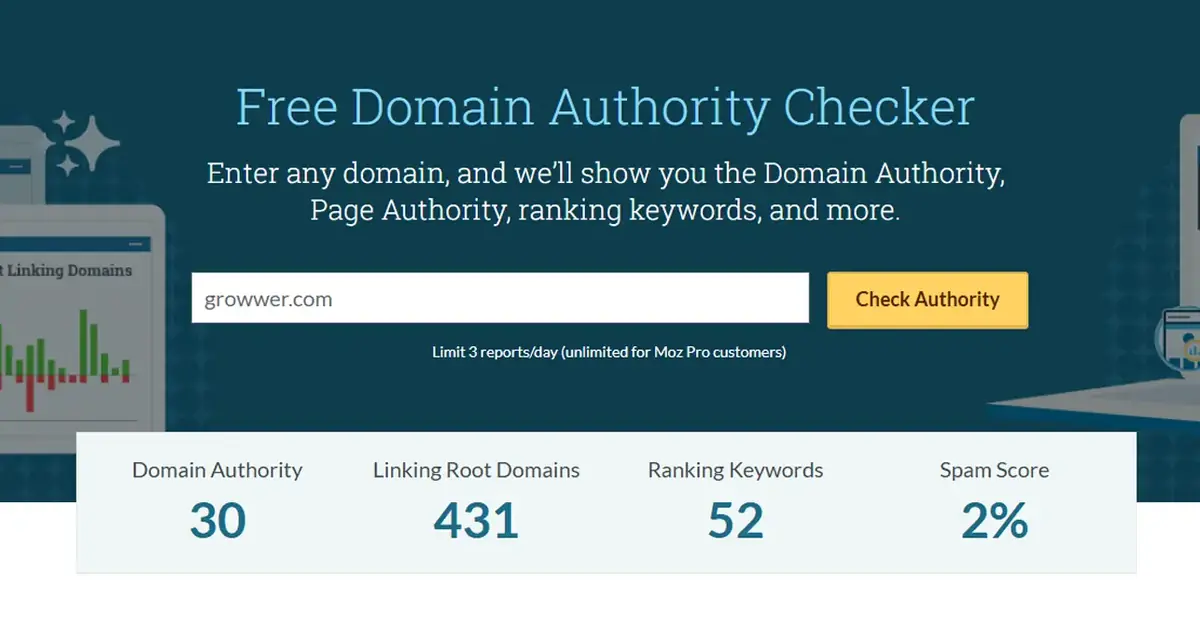
To find out your domain authority, Moz offers a free tool that we can use by following these steps:
- Visit the website: Go to Moz Domain Analysis.
- Enter your domain: On the home page, you'll find a search field where you can enter your website's domain. Type the full URL of your domain and press “Check Authority”.
- Review the results: Once Moz processes your request, it will give you a detailed analysis of your domain. Among the data shown, you'll find the “Domain Authority” (DA).
- Analyze other useful data: Besides domain authority, Moz will also show you other important metrics such as the number of inbound links, the quality of those links, the spam score and other statistics that can help you better understand your site's SEO health.
Moz Domain Analysis is a valuable tool for getting a quick, free overview of your site's performance.
How do you increase domain authority?
Increasing a website's domain authority (Domain Authority, DA) is important to improve its visibility and rankings.
Below, we show you 6 strategies you can use to improve your website and increase this metric.
Get more links (backlinks)
The most important factor in increasing domain authority is getting high-quality backlinks. Links from domains with higher authority pass “link juice” to your site, improving its DA.
You need to prioritize quality over quantity, avoiding links from low-quality or penalized sites.
To do this, develop a solid link building strategy that includes the following tactics:
- Guest posting: Publish guest articles on blogs and sites in your industry. This
not only generates backlinks, it also exposes your content to a wider audience.
If you go for this strategy, you can follow these 7 tips for writing guest posts for SEO. - Sponsored posts: Invest in sponsored posts on high-quality, relevant sites.
- Broken links: Use tools like Screaming Frog or Ahrefs to identify and fix broken links on your site and on other sites that could link to your pages.
- Proactive strategy: Reach out to high-authority sites and ask them to link to your content. Make sure your content is valuable and relevant enough to justify the link.
Link building takes a lot of time, and our tool cuts this process down to just minutes. With a quick, free sign-up, you'll get access to more than 30,000 media outlets and blogs from all over the world, filtered to your needs and ready to offer you posts with links that meet Google's quality standards.
On the other hand, if you don't have the time or the know-how to do this task, you can opt for our managed service, where our Growwer team will take care of everything for you.
Also, if you're looking to buy quality backlinks at the best price, you can use Growwer to import the media outlets you find on other platforms or online, so you can compare prices and always get the best deal.
Using Growwer is very easy; just follow these simple steps:
- Sign up in the .
- Go to the buyer section.
- Go to “Add Project” to register your website.
- Fill in the basic information requested in the project generation process.
- After this process, the system will start cross-referencing all the project needs information with the database in order to find the sites where your website can get the best SEO link.
On-page SEO
Besides link building, optimize your on-page SEO. Make sure your pages are well structured, with proper meta tags, quality content and effective use of keywords. An SEO audit can help you identify areas for improvement.
Publish quality content
The content you offer your audience defines your authority. Make sure your content is:
- Original: Avoid plagiarism and duplicate content.
- Natural: Say no to over-optimization and automated content.
- Relevant: Provide value to your target audience.
- Varied: Include posts, webinars, infographics, podcasts, etc.
- Regular: Publish new content often to maintain and increase your DA.
Use tools like Google Trends and Buzzsumo to identify relevant, trending topics that attract your audience.
Improve your internal linking structure
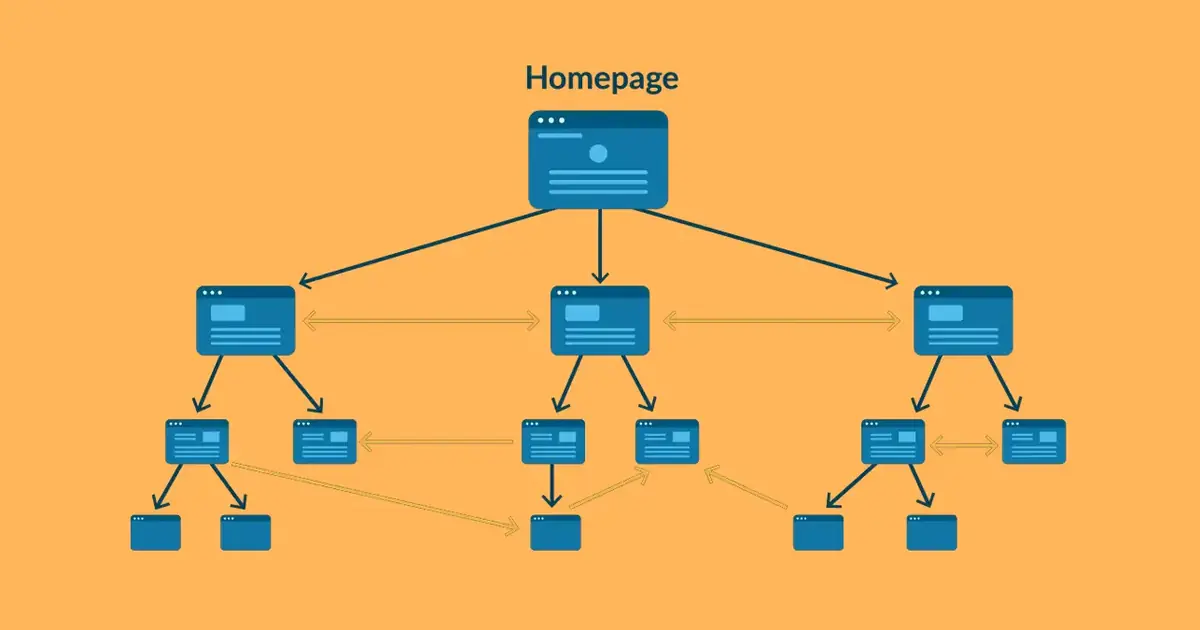
A good internal linking structure makes your site easier to navigate and index. When you create new content, link naturally to other related articles on your website.
This not only improves the user experience, it also distributes link juice internally, boosting your domain authority. Vary your anchor texts and keep a balance between internal and external links.
Use social media
Content marketing should be complemented by a social media promotion strategy. Promote your content on platforms like Facebook, Twitter and LinkedIn, and make sure to include share buttons in your articles.
Being active on social media can also generate more traffic and backlinks, which increases your DA.

Improve your website's usability and navigation
User experience (UX), although not directly, has a significant impact on domain authority. Make sure your website is:
- Fast: Slow loading can increase bounce rates and hurt your SEO. Use tools like PageSpeed Insights to improve your site's speed.
- Responsive: Optimize your site for mobile devices, since a large share of web traffic comes from these devices.
- Intuitive: Make navigation easy with clear, functional menus. Use analytics tools such as heatmaps to identify and improve the key areas of your website.
As we've seen, this metric not only reflects a site's reputation and trustworthiness, it also opens the door to better rankings in the SERPs, greater visibility and, ultimately, a significant increase in traffic and conversions, so it's important to optimize it so you know you're on the right track.
And you? Are you ready to become an authority in your niche and attract thousands of visitors every day?