Written by Lucía y el SEO
A promotion plan is useful both for marketing in general and for search engine optimization.
When it comes to SEO, popularity is one of the aspects you need to work on, and backlinks are an essential factor for that. Social signals also do their bit, and besides driving traffic they help us build a consistent brand image.
That's why, so as not to leave things to chance, we usually work with an essential tool for the development and growth of online businesses: the promotion plan, or promotion calendar.
Let's look at what a promotion plan is and how to create one in just 7 steps.
What is a distribution and promotion plan?
A promotion plan is the document that gathers all the promotion you are going to do for the content we create online, whether it's a blog article, a YouTube video or content on our social media.
I often find that a lot of work goes into the content, but promotion gets a much lighter touch and, in general, we limit ourselves to sharing it on our social media and little else.
Promoting our content is the wide-angle lens of an effective content strategy: it lets your content reach more people and, as a result, it generates positive signals that Google reads as valuable content, improving its position in the rankings (as long as the rest of the SEO aspects are well handled).
Investing many hours in creating high-quality content requires you to invest at least the same amount of time in getting that content known.
To keep your content from going to waste, we're going to build a promotion plan that helps your content reach the right audience, starting from the origin (creating the content) all the way to its distribution to the end user.
Ready to put together your promotion plan?
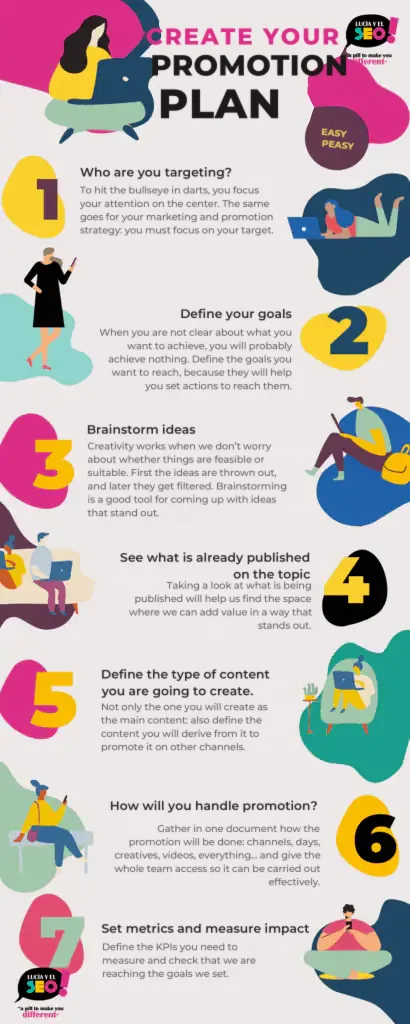
How do you make a promotion plan?
To make a promotion plan we need to know what type of content we are going to create, on which channels, and who the person or people creating it will be, whether it needs creatives and in what format, what goal that content is meant to achieve…
In other words, to make a promotion plan we need to know the goals that content is meant to achieve.
How do you choose the goals? What do we base our choice of content topics on?
This is where I tell you my favorite word: business model.
You need to know your business model and the strategic planning you've done based on your business.
The content you share today must be aligned with what your company is going to do in the coming months.
Fashion is a great example of a promotion plan: there you are, bundled up to your eyeballs in December, watching the runway shows of next year's spring and summer collections.
You see ads, magazines, trend analyses… and what happens? Their content aims to inform the reader, giving them the resources they need to form a mental picture of what's going to be in style, which products are the must-haves and which brands are behind them.
So in February, when the sales start, people are going to look for something related to those products, which you have very cleverly worked on through your sales must-haves.
You align your strategic plan with your promotion plan.
The fashion example is quite vivid because it highlights the key part of a promotion plan: planning.
What are the distribution channels?
Distribution channels are all the media through which we'll give visibility to our content. The distribution channels we choose should be the ones where the customer profile we're targeting can be found.
For me, a promotion plan is one of the last tools we need to put together; the first thing will always be defining our business model.
To do that I use the business model canvas because it lets me see, in a very visual way, how the company makes money and the market segments it targets.
Based on the customer segments we have, we can define which distribution channels we should work on in our media promotion plan.
If my audience is people over 45, TikTok wouldn't be one of the main distribution channels I should work on.
Stages to create a promotion calendar
If you want to create a promotion calendar, the first thing you need to be clear about is your market segment. That way, your promotion plan will be more effective than if you simply try to be present on every channel.
Your promotion plan should focus on:
- Being present where your market segment is
- Creating posts with a clear goal
- Setting up different types of content
- Analyzing the content being published in your sector
- Finding the space where we can create something that stands out.
- Measuring and taking action based on that feedback
If you're not getting the results you expect from your promotion plan, it's not because it's “complicated” (which it is); it's also because either you're not consistent enough or you're taking actions based on what others in the sector are doing or on what you believe (thanks to your intuition) might work.
The crystal ball… rarely works. If you find yourself in a situation where your interactions and reach are not what you expected… here are the stages to create your promotion calendar.

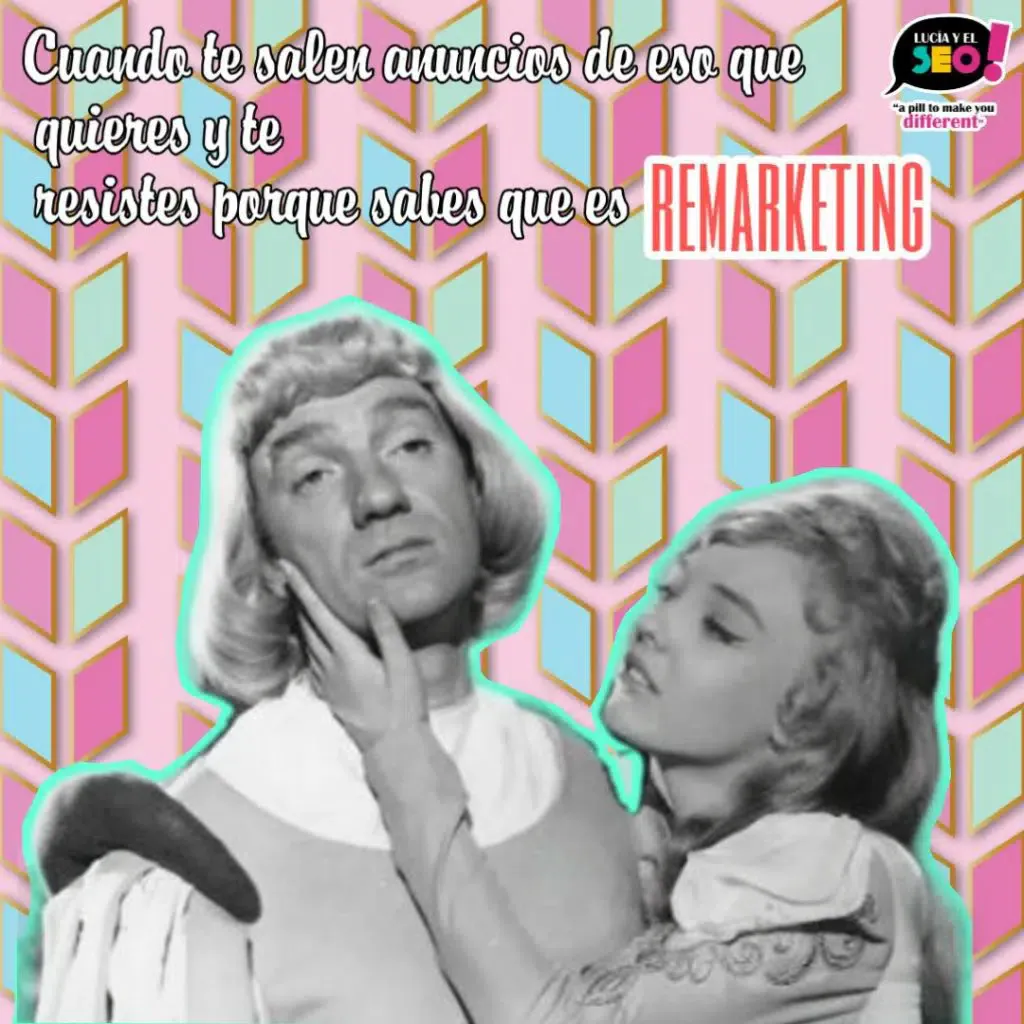
That's how one day, at a conference, someone said to me: “You're the Marujita Díaz one”
That promotion strategy wasn't the typical one for an SEO specialist, and that's exactly why the strategy achieved its goal.

2. Define the goals we want to achieve
As I said in the previous example, the target must be clearly defined. We also need to set the goals we want to achieve.
For that, I like to use the well-known Purchase Funnel.
When launching a product or service, we need to identify in the funnel the stage a company is at online.
Your company may have been around for 8 years with stable offline growth. However, its level of digital maturity may be low.
In that case, which is much more common than we think, the promotion plan should focus on making the company known.
To do that, we'll use owned and paid media, and our goal won't be to focus on getting customers.
In this situation, our goal is for our company to be known and recognized in the digital space.
Our company may already be known and recognized online and be in the consideration stage.
However, it doesn't convert as expected.
In this case, our promotion calendar should focus on improving the brand image with an emphasis on the value proposition to increase conversions, and we'll focus the efforts of our promotion plan on the media …
Our goal will no longer be brand awareness; our goal with the promotion plan will focus on increasing conversions and micro-conversions.
3. Create a mind map or brainstorm to come up with content ideas
At this point we'll already have a clearer idea of both our positioning as a company and the target we're addressing.
In the brainstorming phase of our promotion calendar we must involve everyone who takes part in content creation: from the Head of SEO to the graphic or audiovisual designer, including copywriters, ads specialists… in short, the whole team involved.
The idea of brainstorming is to get a joined-up view from every area, which will enrich the ideas.
It's important to stress that in brainstorming sessions there are no bad ideas, and ideas are not judged, even if they seem totally st*pid to us.
The idea is to gather a large collection of content ideas that help us shape a content strategy with high differential value.
4. Analyze the content that already exists on those topics
This is the most fun part.
And I say fun because, to recap, we now know a lot of things:
- We know who we're targeting
- We know what we want to achieve
- We have a ton of content ideas
Now we look at what the competition is doing and, thanks to that information, I promise you'll see their content with different eyes.
Now you'll notice what's missing, the things they didn't take into account in their promotion plan
You'll notice whether their posts are goal-oriented
You'll take note of their hashtags and the promotion strategies they use… and you'll find yourself sharpening your pencil to make your promotion plan better 😉
5. Define the type of content we're going to create
The promotion plan is an extension of your content plan, so now that we know what the competition is doing and we're clear on where we can carve out a space, it's time to define the type of content we're going to create.
On social media, my bet is to play with the type of content, because it's the only way we can validate which content type works best for our target audience.
On the website we need content that is relevant to users and that interests readers (we'll determine this with keyword research), relying on our business model to identify the products or services that bring us the most profit, or the products we have excess stock of and need to move.
As for the blog, we could work on it as follows:
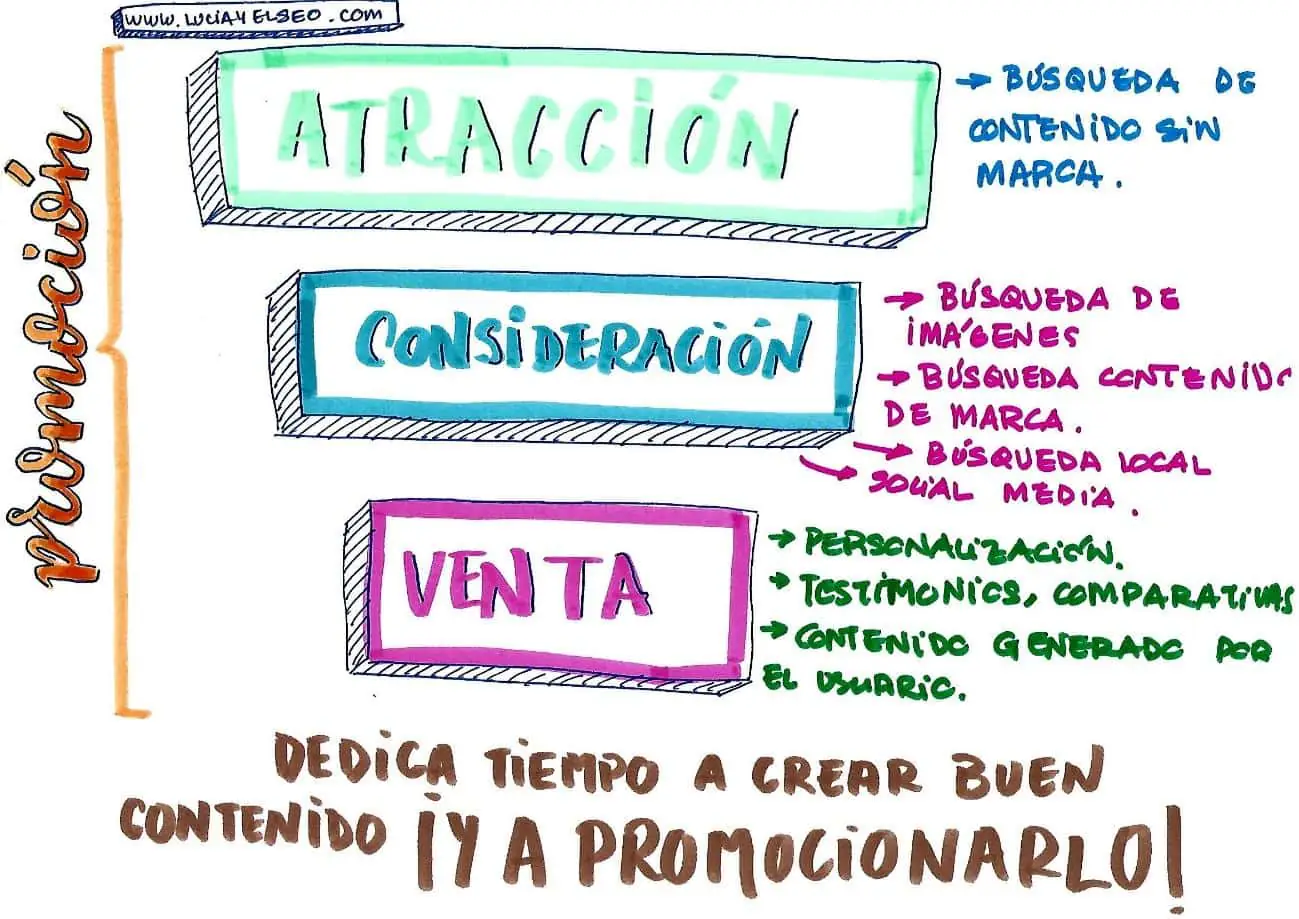
6. Decide how we're going to promote our content
Now that we know the content we're going to work on for our website and how we're going to present it on the different social networks, it's time to gather it all in one document: the promotion plan.
We can build the promotion plan in an Excel document where we list each of the channels on which we're going to promote content.
We'll also include the type of content each post will contain (video, infographic, image, carousel, short video, reels, IGTV, link, guest post, sponsored article,…)
In addition, we must include in our promotion plan the date or day on which each of those tasks will be carried out.
We could define the promotion calendar as a tactical plan of our marketing strategy.
All of this should be gathered in an Excel document, a Trello board or any other channel where any team member can see the promotion plan.
Besides the topic the content will cover, this document should also include the deadline, the person or people responsible for it, the extra content needed to complement that content (photos, creatives, videos, infographics…), the channels through which you want to promote it (social media, email marketing,) and the format that content needs so it can be promoted on those channels.
In other words, the promotion plan includes EVERYTHING that needs to be done so that the team is in sync and can do a good job of promotion.
Content isn't meant to sit in a drawer.
If you really want the content you create to help you achieve your brand goals, you should focus more on promoting that content than on producing it.
7. Set metrics and measure impact
Set metrics that help you determine whether the promotion calendar is well focused.
To do so, we'll need to set metrics based on the goal we have for each of our posts and interactions.
If we want to work on the attraction stage of our content, the metric could be the number of times that content is shared, the impressions or the reach.
If we want to work on the consideration stage, the metrics could be the comments, private messages, Newsletter subscriptions, CTR or the customer journey the user follows through our website.
If we're working on the sales stage, the most obvious metric would be quote requests, but there are more.
Which distribution channels should you include in your promotion plan?
It may sound like a cliché, but the distribution channels you should include in your promotion plan will depend a lot on the audience you're targeting.
As you probably know, you don't need to be on every social network, and for your efforts to be effective in terms of financial return, you should focus on the channels that give you the lowest cost per lead.
In other words, you should focus on the channels where it's easiest for you to get leads.
Does that mean that if your potential customer is on TikTok you shouldn't work on LinkedIn?
No.
It means that if your customer is on TikTok, TikTok should be the center of your communication, and if you want to be present on LinkedIn (for whatever reason), your communication on that social network should be secondary.
So, if you want to know which channels are yours, you just need to look at your market segments and build the well-known buyer persona. You can also make an empathy map, which is basically the same thing (but not quite, because everything sounds better in English)
Conclusion on the promotion plan
With more and more businesses going digital, it's easier for our website to get lost in the forest.
That's why the best way to get the reach we need to achieve our business goals is to create a content plan.
Let's say that, in the digital world, the promotion plan is the equivalent of attending networking events where we can show ourselves to the world and interact with people who may be interested in our product or service.
There's a saying in business management that nothing happens inside the office. Extrapolated to the world of digital business, we could say that nothing happens if you don't give your content visibility, and you'll get that visibility through a promotion strategy set out in a promotion plan.

Lucía y el SEO
My name is Lucía Rico. I studied business and worked somewhere boring until I realized that my thing is the sales and marketing side of companies. I'm curious, methodical and goal-oriented. I read a lot of Mortadelo y Filemón as a kid and, like Ibáñez, I put the title in the middle of the comic. Because it's cool. At Lucía y el SEO we love creativity, humanizing brands and making companies better known online. My goal is for you to reach your goal. I work in SEO and online marketing in Badajoz. However, digitalization brings us closer and lets me work with clients in other cities.